
Bay Village sits right on the Lake Erie shoreline, and that lakefront setting is exactly what makes its roofs so exposed. Homes along Lake Road, through the Cahoon Memorial Park corridor, and across the Glenview and Bradley Road neighborhoods face wind coming straight off open water with nothing to slow it down. When a fast-moving system rolls in off the lake, the gusts that reach these streets hit harder than they do for inland communities just a few miles south.
Add in Bay Village’s stock of established, higher-value homes — many with mature trees overhead — and you have a community where storm season produces real, expensive roof damage every year. If your roof was hit, GRT Roofing handles 24/7 emergency response, storm damage roof repair, and the insurance documentation that goes with it. Call (440) 739-7672 to get a crew working on your home.
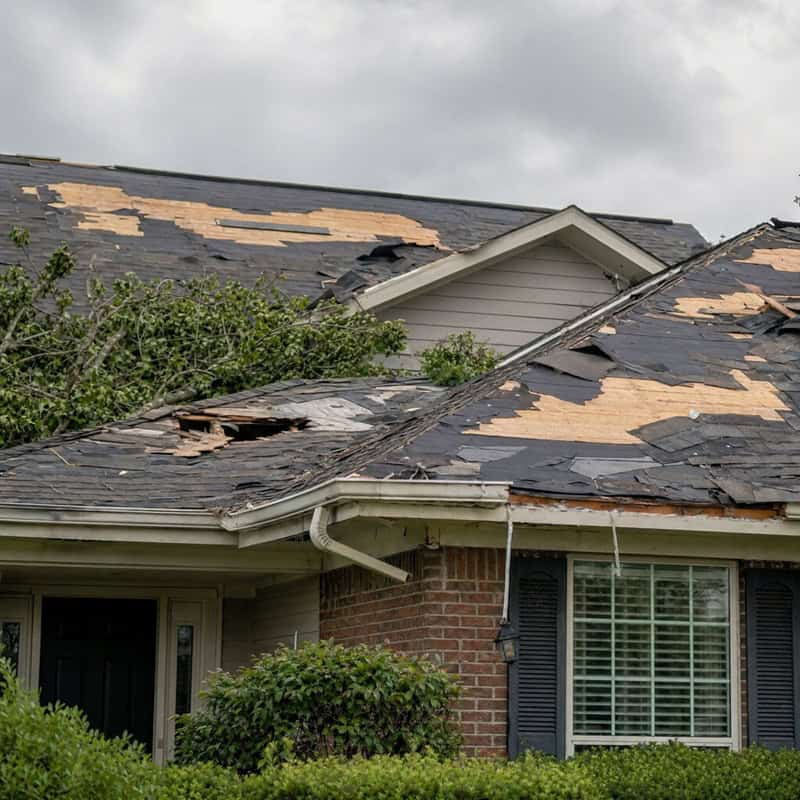
Lake Erie is shallow and oriented east-to-west, which lets wind build long, unbroken fetch across the water before it reaches the Bay Village shore. The National Weather Service notes that sustained winds of just 40–50 mph are enough to cause isolated damage, with widespread damage at higher speeds — and lakefront properties routinely see the stronger end of that range. The result is constant uplift pressure on shingles, especially along roof edges, ridges, and rakes, where wind gets underneath the material and peels it back.
The most common storm-damage patterns we see on Bay Village roofs are: wind uplift that loosens, creases, or tears off shingles; impact damage from wind-driven debris and falling limbs; and water intrusion driven sideways under lifted shingles and flashing by the rain that rides the wind. Lake-effect events can also pile heavy, wet snow that stresses older roofs through the winter. Damage from any of these is often subtle from the ground — a few missing tabs or a lifted edge — while the real problem is the water now reaching the decking underneath.
The first job after a storm is to stop the damage from getting worse. Once water finds its way past the roofing surface, every hour of exposure means more soaked decking, insulation, and drywall — and a bigger, costlier repair. That is why emergency tarping is our fastest service: a properly secured tarp buys you time to handle the insurance process and schedule a permanent fix without water continuing to pour into your home.
GRT Roofing answers emergency storm calls for Bay Village and the surrounding lakefront communities 24/7. During a widespread event, response timing depends on weather, road conditions, and how many homes are calling at once, so reach out as early as you can if you have an active leak — the sooner we know, the sooner we can prioritize your home. If you also have overflowing or torn-away gutters after the storm, ask about our storm drain services while we are on-site. Call (440) 739-7672.
Most Ohio homeowners policies cover sudden, accidental storm damage — wind, hail, and falling debris are typically named perils. What your policy pays toward the repair or full replacement depends on your specific coverage, your deductible, and the age and condition of your roof at the time of the loss. The Insurance Information Institute lays out the homeowners claim process step by step, and one of its first recommendations is to document the loss and make reasonable temporary repairs to prevent further damage — exactly what an emergency tarp accomplishes.
Carriers commonly written across Northeast Ohio include State Farm, Allstate, Nationwide, Erie Insurance, Westfield, Grange, and Progressive, among others. GRT Roofing documents the damage thoroughly so your adjuster has clear evidence of what the storm did and when. We can meet your adjuster on-site, point out damage that’s easy to miss from the ground, and provide a detailed scope of the work. To be clear about roles: we document and advocate for an accurate scope, but your insurance carrier makes the final coverage decision — we don’t determine what your policy pays.
Documentation is the single most useful thing you can do for your own claim, and the best window is before any temporary repair changes the scene. If it’s safe, capture the following — all from the ground, never by climbing a wet or damaged roof:
Keep any shingles or materials that blew off if you can do so safely — they’re physical evidence of the loss. Save this all in one place so it’s ready when your adjuster asks.

Emergency tarping is a temporary measure, not a repair. A crew secures a heavy-duty tarp over the damaged area — fastened and weighted so wind off the lake won’t lift it — to keep water out until permanent work can be scheduled and (if applicable) approved by your insurer. It protects the interior of your home and prevents a contained problem from spreading into the framing and living space.
Cost generally runs a few hundred dollars depending on the size and pitch of the roof and how large an area needs covering. On a covered claim, reasonable emergency mitigation is often reimbursable, so keep your receipt alongside your photos. The point of tarping is simple math: a modest spend now usually prevents thousands in additional water damage later.
After the emergency is handled, the real question is whether your roof needs a targeted repair or a full roof replacement. Use this as a guide — a professional roof inspection confirms which path fits your situation:
There’s no one-size answer — a newer roof with one damaged slope and an older roof with damage across three are different problems. An honest inspection gives you a clear recommendation either way.
GRT Roofing operates as a trade name of Connecticut Masonry & Waterproofing, Inc., and has served Greater Cleveland since 2019, backed by a team carrying more than 25 years of combined experience in roofing and exterior work. Based at 25118 Lorain Rd in North Olmsted, co-owners Terry Hess and Rick Zitello run a company built on doing the work right and being straight with homeowners about what they actually need.
For storm work specifically, that means honest repair-versus-replace guidance, thorough damage documentation that supports your insurance claim, and 24/7 emergency response that protects your home before the small problem becomes a big one. We know the Bay Village lakefront and the way Lake Erie weather treats these roofs — and we serve neighboring lakefront communities like Avon Lake, Westlake, and Rocky River as well. When a storm hits, call (440) 739-7672 or request a free estimate — we’ll get a crew on your home and walk you through every step. Learn more about our Bay Village roofing services.
Get everyone to safety, then document the damage from the ground with photos and video before touching anything. Call a licensed roofer for an emergency tarp to stop further water intrusion, and contact your insurance carrier to open a claim. Avoid climbing onto a wet or damaged roof yourself.
Yes. GRT Roofing provides 24/7 emergency storm-damage response for Bay Village and the surrounding Cuyahoga County lakefront communities, including emergency tarping to protect your home until permanent repairs can be scheduled. Call (440) 739-7672.
Most Ohio homeowners policies cover sudden, accidental storm damage from wind, hail, and falling debris. Coverage for the full repair or replacement depends on your policy, your deductible, and the age and condition of the roof. GRT can document the damage to support your claim, but your carrier makes the final determination.
Emergency tarping is our fastest service because it stops further interior damage. Response time depends on weather, road conditions, and call volume during a widespread storm event. Call as early as possible so we can prioritize active leaks — our emergency line is staffed 24/7.
Emergency tarping is typically a few hundred dollars depending on roof size, pitch, and the area that needs covering. In a covered insurance claim, reasonable emergency mitigation costs are often reimbursable, so keep your receipt and photos.
It depends on the extent and location of the damage, the age of the roof, and whether the underlying decking is compromised. Isolated wind or impact damage on a newer roof is often repairable; widespread damage or an older roof near the end of its service life usually points toward replacement. A professional inspection will tell you which makes sense.
Photograph the roof from the ground and the surrounding property, capture any interior leaks or water stains, and note the date and time of the storm. Save damaged materials if it is safe to do so. Detailed documentation before any temporary repair helps your adjuster verify the cause and extent of the loss.
Wind uplift that lifts or tears off shingles, impact damage from wind-driven debris and tree limbs, and water intrusion from wind-driven rain are the most common. The lakefront exposure along Lake Erie means Bay Village homes see stronger sustained winds and gusts than inland properties.
Yes. GRT Roofing operates as a trade name of Connecticut Masonry & Waterproofing, Inc., and carries the licensing and insurance required to perform roofing work in Cuyahoga County and the Greater Cleveland area.
A localized repair is often completed in a day once materials are on hand. A full replacement typically takes one to a few days depending on roof size, complexity, and weather. Insurance approval timelines can add to the overall schedule.
Roof damaged by a storm?
Call GRT Roofing now: (440) 739-7672 — 24/7 emergency service. Emergency tarping available ·
We document your damage for insurance · Serving Bay Village & the Lake Erie shore.