
By Terry & Rick, Owner — GRT Roofing (North Olmsted, OH)
If you own a home in Westlake, your roof is quietly doing one of the hardest jobs in Northeast Ohio. It stands between your family and everything Lake Erie can throw at it — driving winds off the water, freeze-thaw cycles that repeat dozens of times each winter, ice dams along the eaves, and the occasional summer storm that peels shingles off in minutes. And it does this year after year, usually without anyone thinking about it until a stain appears on a bedroom ceiling.
This guide is written for Westlake homeowners who want to understand their roof the way a good contractor does: what the local climate does to it, when it genuinely needs replacing versus when a repair will do, what materials actually make sense for our corner of Cuyahoga County, what the work should cost in 2026, how to navigate a storm-damage insurance claim, and how to tell a trustworthy roofer from a storm-chaser knocking on your door. It is long on purpose. Roofing is a five-figure decision on most homes, and you deserve more than a sales pitch before you make it.
We are GRT Roofing, a family-owned company based just down Lorain Road in North Olmsted, serving Westlake and the west-side suburbs since 2019 with a team that carries more than 25 years of roofing experience. We wrote this guide the way we would explain things to a neighbor at the kitchen table — no jargon for its own sake, no scare tactics, and honest about the times a full replacement isn’t the answer.

The Westlake Roofing Market at a Glance
Westlake sits on the western edge of Cuyahoga County, a few miles inland from the Lake Erie shoreline. That location shapes almost everything about how roofs perform here. The city is a mix of housing eras, and the age of your home is often the single best predictor of what your roof needs.
A large share of Westlake’s housing stock went up during the post-war and mid-century boom — ranches and split-levels from the 1950s through the 1970s, followed by a wave of colonials and two-stories through the 1980s and 1990s. More recent decades added larger custom homes and newer subdivisions on the city’s south and west sides. Each era brings its own roofing quirks: older homes frequently have simpler gable rooflines but may hide multiple layers of old shingles and dated, under-ventilated attics; newer homes tend toward more complex rooflines with more valleys, dormers, and hips, which look great but create more places for water to concentrate.
Because asphalt shingles are by far the most common roofing material in the area, and because a typical architectural asphalt roof in this climate lasts roughly 20 to 25 years, a great many Westlake roofs installed during the building activity of the late 1990s and early 2000s are now reaching the end of their service life at the same time. If your home was built or last re-roofed 20 or more years ago, you are squarely in the window where inspection and planning make sense — not necessarily because something is wrong today, but because getting ahead of a failure is far cheaper than reacting to one.
The other defining feature of the Westlake market is competition and, unfortunately, opportunism. After any significant wind or hail event, out-of-town crews descend on the west side looking for quick insurance jobs. Some are legitimate. Many are not. A big part of being a smart Westlake homeowner is knowing how to separate the neighbors-you-can-call-back-in-ten-years from the crews that will be three states away by the time your first leak shows up. We cover exactly how to do that later in this guide.
Throughout this guide we’ll point you toward our dedicated Westlake roof replacement page for homeowners who already know they need a new roof and want local specifics on our process, warranties, and financing. Think of this article as the education, and that page as the next step.

How Lake Erie Weather Shapes Westlake Roofs
You cannot understand roofing in Westlake without understanding Lake Erie. The lake is shallow, which means it heats up and cools down faster than the deeper Great Lakes, and that drives a set of weather patterns that are genuinely tougher on roofs than most of Ohio experiences.
Wind is the first factor. Westlake gets sustained winds and gusts blowing in off open water with very little to slow them down. Wind doesn’t usually rip a whole roof off at once; it works at the edges. It lifts and flexes shingles along the eaves, rakes, and ridges — the perimeter — loosening the adhesive strips and backing out nails a fraction of an inch at a time. Years of this fatigue is why so many local roofs fail at the edges first, and why proper edge detailing and high-wind-rated shingles matter far more here than in a sheltered inland town.
The second factor, and arguably the most destructive, is the freeze-thaw cycle. Northeast Ohio doesn’t just get cold and stay cold. Temperatures swing across the freezing point again and again through the winter — a thaw during the day, a hard freeze overnight, repeated dozens of times. Every time water gets into a small crack or under a shingle and then freezes, it expands and makes that crack a little bigger. Freeze-thaw is a slow demolition crew. It’s the reason a hairline flaw in flashing or an aging sealant joint that would last for years in a milder climate can turn into an active leak in a single Westlake winter.
Third are ice dams. When heat escapes from a poorly insulated or under-ventilated attic, it melts the snow on the upper part of the roof. That meltwater runs down to the cold eaves and gutters, where it refreezes into a ridge of ice. The dam then traps the next round of meltwater behind it, and that standing water backs up under the shingles and into the home. Ice dams are one of the most common causes of winter leaks in Westlake, and — this is the important part — they are usually an attic and ventilation problem wearing a roofing costume. A good contractor treats the cause, not just the symptom, which is exactly what we walk through in our guide to preventing ice dams on Westlake homes.
Fourth is snow load. We don’t get the extreme lake-effect totals that hammer the snowbelt on the east side of Cleveland, but Westlake still sees heavy, wet snow that adds real weight to a roof structure, especially where drifting piles it up in valleys and against dormers. On a sound roof this is a non-issue. On a roof with compromised decking or sagging framing, a heavy snow load is what turns a hidden weakness into a visible one.
Finally there’s summer. Intense UV and heat during our humid summers bake the oils out of asphalt shingles over time, making them brittle and prone to cracking and granule loss. And the region’s periodic severe thunderstorms bring the two things that trigger most insurance claims: high straight-line winds and hail. A single strong storm can end the life of a roof that the daily grind had already worn thin.
The practical takeaway is this: a roof in Westlake is fighting a longer and harder battle than the same roof would in most of the country. That is exactly why cutting corners on materials, ventilation, or installation quality costs you far more here than it would elsewhere — and why storm-damage repair is something local homeowners should take seriously rather than defer.
Westlake Building Codes & Roofing Permits
Here is something a lot of homeowners don’t realize: in Westlake, replacing your roof requires a permit. The city’s Building Department explicitly lists roof replacement among the projects that need one, right alongside windows, siding, and mechanical work. This is not red tape for its own sake — the permit and inspection process is what protects you from a crew that would otherwise skip code-required steps you can’t see once the shingles are on.
Roofing in Westlake falls under the Ohio Building Code, the Residential Code of Ohio, and the city’s own zoning and property-maintenance codes. A few specifics are worth knowing before you hire anyone.
First, the permit itself. Westlake uses a separate roofing permit application rather than folding it into the general building permit, and applications are handled through the Building Department at City Hall, 27700 Hilliard Boulevard, generally 8:00 a.m. to 5:00 p.m. Monday through Friday. Permit fees in the city start modestly — on the order of $25 as a base — with additional charges scaled to the size and scope of the job. In practice the permit is a small line item on a full replacement, and a reputable contractor pulls it as a matter of course and bakes the cost into the quote.
Second, contractor registration. Westlake requires that the contractor doing the work be registered with the city, and the city maintains a searchable database of registered contractors. This exists to confirm that whoever climbs on your roof is properly bonded and licensed to do the work. It is also one of the easiest ways for you to vet a company before you sign anything: if a roofer isn’t willing or able to pull a Westlake permit under their own registration, that tells you something important.
Third, the code triggers most relevant to roofing. Across Cuyahoga County, a full roof replacement essentially always requires a permit. Repairs can require one too, depending on scope — the common threshold used across Ohio is that work replacing more than roughly 25% of the roof decking, or any work touching structural framing, ventilation, or drainage, crosses into permit territory. Simple, small repairs like swapping a handful of shingles typically do not. When in doubt, the honest answer is to ask, and the Westlake Building Department can be reached directly to confirm.
Fourth — and this is where Northeast Ohio’s code really earns its keep — the inspection focuses heavily on the things our climate punishes. Inspectors here care about proper ice-and-water-shield membrane along the eaves and in the valleys (your first line of defense against ice-dam backup), about ventilation that actually meets code (the fix for the attic-heat problem that causes ice dams in the first place), and about correct flashing and structural integrity. These are precisely the details a cut-rate crew skips because you’ll never see them from the ground. The permit and the inspection are what force them to be done right.
The bottom line for a homeowner: you want a contractor who treats the permit as normal and non-negotiable, pulls it under their own city registration, schedules the inspections, and closes the permit out at the end. An unpermitted roof can create real problems when you sell your home, and it strips away the independent check that the work met code. If a bid comes in suspiciously low and the reason turns out to be ‘we skip the permit,’ that discount is a liability, not a savings.
You can confirm current requirements, fees, and the searchable registered-contractor database directly through the City of Westlake Permits and Contractor Information page — a good habit before hiring anyone. When you’re ready to move forward, our Westlake roof replacement process spells out how we handle permitting and inspections for you.
When a Westlake Home Actually Needs a New Roof
Not every problem roof needs to be replaced, and any contractor who tells you otherwise before they’ve been in your attic is selling, not diagnosing. That said, there are clear signals that a roof has reached the end of the road. Here is how we think about it, grouped into age signals, visual signs, and neighborhood patterns.
Start with age, because it’s the most reliable single factor. A standard architectural asphalt shingle roof in the Westlake climate typically gives you 20 to 25 years of real service — often less if it was a builder-grade three-tab shingle, was poorly ventilated, or was installed over an existing layer. If your roof is past the 20-year mark, it isn’t necessarily failing, but it has spent its warranty life fighting Lake Erie, and it deserves a professional inspection rather than a wait-and-see approach. Roofs rarely fail politely; they tend to fail in February.
The visual signs are what most homeowners notice first. From the ground or a safe vantage point, watch for shingles that are curling or cupping at the edges, cracked or broken shingles, and bald patches where the protective granules have worn away (you may also find piles of those granules in your gutters or at the bottom of downspouts — a sign the shingles are aging out). Missing shingles after a windstorm, shingles that look dark and ‘wet’ in patches even when dry, and a roofline that visibly sags or dips all point toward serious trouble. Around chimneys, vents, and in valleys, rusted or lifting flashing is a frequent leak source.
Inside the house, the tells move to the attic and ceilings. Water stains on upper-floor ceilings or on the underside of the roof deck, daylight visible through the roof boards, damp or matted insulation, and a musty smell in the attic all indicate that water is already getting in. A spike in heating or cooling bills can point to failed attic ventilation, which — as we’ve covered — is tied directly to both roof lifespan and ice-dam risk; it’s worth understanding how attic ventilation affects your roof’s lifespan before you assume the shingles alone are to blame.
Neighborhood patterns are the signal homeowners tend to overlook, and in a place like Westlake they’re genuinely useful. Homes in the same subdivision were usually built within a few years of each other, by the same builders, with the same roofing materials, and they’ve all weathered the same storms. When you start seeing dumpsters and roofing crews appear up and down your street, that is not a coincidence — it means an entire cohort of roofs is aging out together. If three of your neighbors with homes the same age as yours have replaced their roofs in the last two years, yours is very likely on the same clock.
So when is it repair versus replace? A good rule of thumb: if the damage is localized, the roof is still within its expected service life, and the underlying decking and structure are sound, a quality repair is often the right, honest answer — and we’ll tell you so. If the problems are widespread, the roof is at or past its age window, or you’re facing your second or third repair in a couple of years, you are usually spending good money chasing a roof that needs to be replaced. The tipping point is when repair costs start to look like a down payment on the replacement you’ll need anyway.
The only way to know for certain is a proper inspection, including a look inside the attic — which is where honest roofing lives, because it’s where you see whether water has already been getting in and whether the decking is still solid. A reputable local company will give you a straight assessment and photos, not a verdict shouted from the driveway.
Choosing the Right Roofing Material for Westlake
The best roofing material for a Westlake home is the one that stands up to Lake Erie’s wind and freeze-thaw punishment, fits the style of your home, and matches your budget and how long you plan to stay. For the large majority of homes here, that means quality asphalt shingles — but the category is wider than most people realize, and there are cases where other materials earn their keep.
Architectural (dimensional) asphalt shingles are the workhorse of the Westlake market, and for good reason. Compared to old-style three-tab shingles, they’re thicker, heavier, more wind-resistant, and far more attractive, with a dimensional shadow line that suits the colonials and two-stories common in the area. A quality architectural shingle from a major manufacturer, installed correctly with proper edge detailing, will typically carry a wind rating well suited to our conditions and last two decades or more. For most homeowners, this is the sweet spot of cost, durability, and looks.
Premium and ‘designer’ asphalt shingles step up from there. These include heavier luxury shingles engineered to mimic the look of wood shake or slate, and impact-resistant (Class 4) shingles built to better withstand hail — which is worth serious consideration in a region that sees periodic hail-bearing storms, and which some insurers reward with a premium discount. If you’re staying in the home long-term or you’ve already been through a hail claim, the upgrade to an impact-rated premium shingle often pays for itself in longevity and reduced future claims. For a fuller side-by-side, see our rundown of the best roofing materials for Ohio’s climate.
Metal roofing is the material most misunderstood by homeowners. It costs more up front — often meaningfully more than asphalt — but a standing-seam metal roof can last 40 to 50 years or longer, sheds snow readily (a real advantage against snow load and ice dams), and stands up superbly to wind. Metal makes the most sense in a few specific situations in Westlake: on low-slope roof sections where shingles don’t perform well, on modern or farmhouse-style homes where the look fits, as accent roofing over porches and bay windows, and for owners who intend to stay for decades and want a roof they’ll likely never replace. It is usually overkill — and a tough resale value proposition — on a starter home you plan to sell in five years.
Other materials show up occasionally. Genuine slate and clay tile are beautiful and effectively permanent, but they’re heavy (often requiring structural reinforcement), expensive, and specialized to install and repair — you see them mostly on older high-end homes. Synthetic slate and composite shingles offer much of the look at a fraction of the weight and cost and are a legitimate option for the right home. Wood shake, once common, has largely fallen out of favor here because of fire and maintenance concerns and our punishing moisture cycles.
Whatever material you choose, three things matter more than the brand name on the shingle wrapper, and they’re the parts a low bidder quietly cuts. The first is the full system beneath the shingles: a quality underlayment, and critically, an ice-and-water-shield membrane along the eaves and valleys, which is your real defense against the ice-dam backup this climate guarantees. The second is ventilation: a balanced intake-and-exhaust attic ventilation system that keeps the deck cold in winter (preventing ice dams) and vents heat in summer (extending shingle life). The third is workmanship: correct flashing at every chimney, vent, and valley, proper nailing, and clean edge detailing. A mid-grade shingle installed as part of a complete, well-ventilated, properly flashed system will outlast a premium shingle slapped on by a crew cutting corners. In Westlake, the system beats the sticker every time.
If you’d like a recommendation matched to your specific home, roofline, and how long you plan to stay, that’s exactly the kind of thing we walk through during a free assessment — and it’s covered in more detail on our Westlake roof replacement page.
Westlake Roofing Cost Ranges (2026)
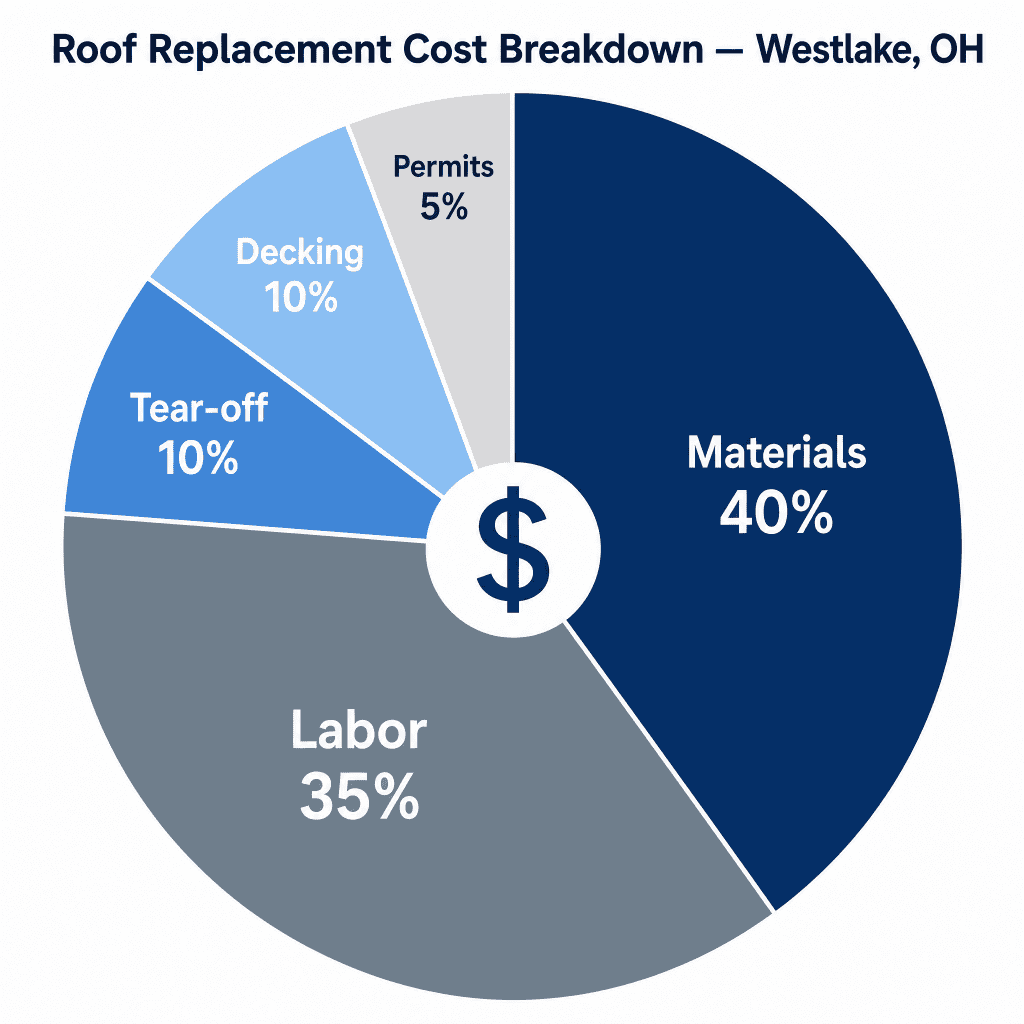
Everyone wants the number, so let’s talk honestly about cost — with the caveat that no responsible contractor can give you an exact price without seeing your roof. Pitch (steepness), the number of stories, the complexity of the roofline (valleys, dormers, hips, and chimneys all add labor), how many old layers have to be torn off, the condition of the decking underneath, and your material choice all move the final figure. The ranges below reflect typical 2026 pricing for a full replacement on a Westlake-area home and are meant to set expectations, not to quote your job.
A few things drive cost that homeowners don’t always anticipate. Tear-off of multiple existing layers adds labor and disposal cost. Rotted or delaminated decking discovered once the old roof is off must be replaced and is usually billed as an extra, which is why a good estimate notes a per-sheet decking replacement price up front rather than surprising you mid-job. Steep and complex roofs cost more per square (a ‘square’ is 100 square feet of roof area) because they’re slower and riskier to work on. And upgrades that are genuinely worth it in this climate — full ice-and-water shield, improved ventilation, premium or impact-rated shingles — add cost that pays back in longevity and fewer claims.
The table below gives ballpark installed cost ranges by roof size and material. Treat these as planning figures for a standard-complexity replacement; a very steep or cut-up roof can run above these ranges, and a simple ranch below them.
| Roof size (approx.) | Architectural asphalt | Premium / impact-resistant | Standing-seam metal |
|---|---|---|---|
| Small (≈1,000–1,500 sq ft roof area) | $6,000 – $10,500 | $9,000 – $14,000 | $16,000 – $26,000 |
| Average (≈1,500–2,200 sq ft roof area) | $9,500 – $16,000 | $14,000 – $22,000 | $24,000 – $40,000 |
| Large (≈2,200–3,000 sq ft roof area) | $15,000 – $24,000 | $21,000 – $33,000 | $38,000 – $60,000 |
| Complex / steep (add-on factor) | +15% – 35% | +15% – 35% | +20% – 40% |
Estimated 2026 installed cost ranges for a standard-complexity Westlake replacement. Not a quote.
Two line items are worth calling out separately. Decking replacement, when needed, commonly runs in the range of $70 to $130 per 4×8 sheet installed, depending on material and accessibility — you won’t know how much (if any) is needed until tear-off exposes the deck, so insist that your contract states the per-sheet price in advance. And the permit, as covered earlier, is a small cost that a reputable contractor includes rather than treating as a way to shave the bid.
One more note on cheap bids. When a quote comes in dramatically below the others, the money has to come from somewhere: thinner or omitted ice-and-water shield, skipped ventilation upgrades, reused old flashing, fewer nails per shingle, no permit, or a crew with no local track record and no meaningful warranty. In Westlake’s climate, those omissions are exactly the things that lead to the leaks and premature failures a new roof is supposed to prevent. The goal isn’t to find the highest bidder — it’s to understand what’s actually in each quote so you’re comparing complete roofs to complete roofs. If you want to see what actually drives the number, we break down how roof replacement costs are calculated in Westlake line by line.
Because a new roof is a significant investment, many Westlake homeowners spread the cost over time rather than paying it all at once. We offer flexible financing options so that choosing the right system — rather than the cheapest one — doesn’t have to strain your budget.
Storm Damage & the Insurance Claim Process
A large share of Westlake roof replacements are paid for, at least in part, by a homeowner’s insurance policy after wind or hail damage — and navigating that process well can be the difference between a smooth, fully covered replacement and a frustrating, out-of-pocket one. Here’s how it actually works, and how to protect yourself.
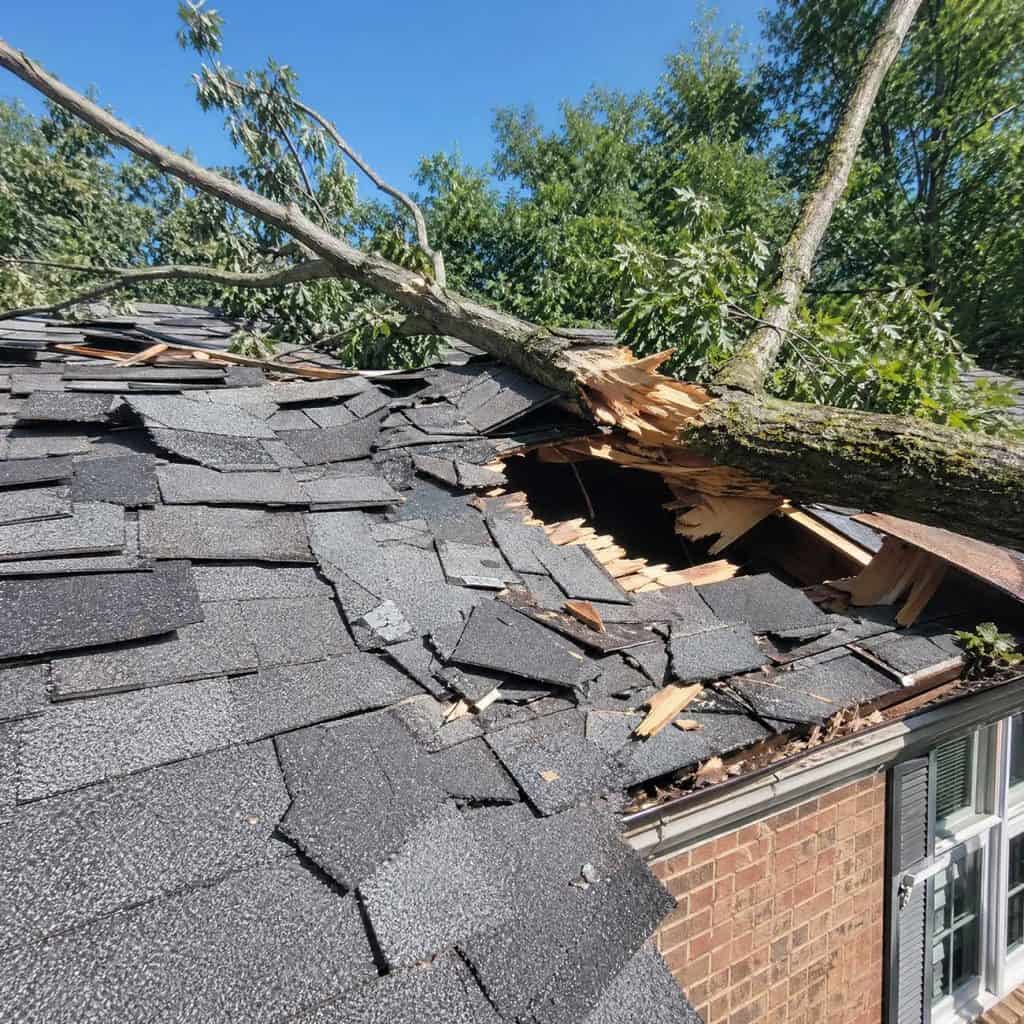
First, understand what’s typically covered. Standard homeowner policies generally cover sudden, accidental damage from a specific event — wind lifting or tearing off shingles, hail bruising the shingle surface, a tree limb punching through the deck. What they generally do not cover is gradual wear, age-related deterioration, or damage that stems from deferred maintenance. This is why the age-versus-storm distinction matters so much: insurers are paying to restore a roof a storm damaged, not to replace a roof that was already worn out. An honest inspection distinguishes storm damage from ordinary aging, and a good contractor won’t encourage you to file a claim that isn’t legitimate.
Second, documentation is everything. After a significant storm, the sequence that serves homeowners best is: (1) make note of the date of the storm; (2) do a safe, ground-level visual check for obvious damage — missing shingles, debris, dented gutters or downspouts, which are often the first visible sign of hail; (3) take clear, dated photos of anything you can see; and (4) get a professional inspection before you file. A reputable local roofer will document damage with photos from the roof itself, which is far more persuasive to an adjuster than a homeowner’s description. If there’s genuine, coverable damage, that documentation is the backbone of your claim — and our step-by-step guide to filing a storm-damage roof insurance claim in Ohio covers the paperwork in detail.
Third, the claim itself. You file with your insurer, who sends an adjuster to inspect. This is a step where having your contractor present matters: an experienced local roofer can meet the adjuster on-site, walk the roof together, and make sure legitimate damage isn’t overlooked or undervalued. Once the claim is approved, the insurer typically issues payment based on the scope they’ve agreed to, minus your deductible. You are responsible for the deductible — and you should be wary of any contractor who offers to ‘waive’ or ‘eat’ your deductible, because that is insurance fraud in Ohio and a bright-red flag that you’re dealing with a bad actor.
Fourth, understand replacement cost versus actual cash value. Many policies pay on a replacement-cost basis, releasing an initial payment and then a final ‘recoverable depreciation’ payment once the work is complete and invoiced. Others pay actual cash value, which factors in the roof’s age and depreciation and leaves you covering more of the gap. Knowing which kind of policy you have before a storm hits is one of the smartest ten minutes a homeowner can spend.
Finally, a word about the storm-chasers this process attracts. After every notable storm, crews from out of state canvass Westlake neighborhoods, knock on doors, and push homeowners to sign paperwork on the spot — often an ‘authorization’ that quietly assigns your insurance benefits to them. Never sign anything under pressure at your door. A legitimate local contractor is happy to inspect, document, and explain your options with no obligation, and will still be here to honor the warranty years from now. The company that pressures you to sign today is the one that can’t afford to let you think it over. We walk homeowners through the entire storm-damage and claims process at no cost, and we’ll give you a straight answer about whether you even have a claim worth filing.
How to Choose a Roofing Contractor in Westlake
Choosing the right contractor matters more than choosing the right shingle. The same materials, installed by a careful local crew versus a rushed out-of-town one, produce roofs with wildly different lifespans. Here’s how to vet a roofer in Westlake, the red flags that should end the conversation, and the questions that separate the professionals from the pretenders.
Start with the non-negotiables. The contractor should be licensed and insured — that means both liability insurance and workers’ compensation coverage, so you’re not exposed if someone is injured on your property. They should be registered with the City of Westlake (remember, the city maintains a searchable registered-contractor database, and registration is required to pull your permit). They should carry a strong Better Business Bureau standing — for reference, GRT Roofing holds an A+ rating with the BBB. And they should be local, with a physical address and a track record in the west-side suburbs, not a crew working out of a truck with an out-of-state plate that appeared after the last storm.
The red flags are just as important as the credentials. Be cautious of any contractor who: pressures you to sign immediately or claims a ‘today only’ price; asks for a large cash deposit up front; offers to waive your insurance deductible (again, that’s fraud); can’t or won’t provide a local address, references, or proof of insurance; wants to skip the permit; or gives you a bid dramatically lower than everyone else with no explanation of what’s different. Door-knocking after a storm isn’t automatically disqualifying, but high-pressure door-knocking is a pattern worth trusting your instincts about — we lay out the roofing scams and storm-chaser tactics to watch for so you can spot them early.
Then ask the right questions. A short list that reveals a lot: Are you registered with the City of Westlake, and will you pull the permit under your registration? Can you provide proof of liability and workers’ comp insurance? Can you share references or recent local addresses I can look at? What exactly does your quote include — ice-and-water shield, ventilation, flashing, decking replacement pricing? Who is actually doing the work — your own crew or subcontractors? What manufacturer and workmanship warranties come with the job, and what would void them? How will you protect my landscaping, gutters, and property during tear-off, and how do you handle cleanup and nail removal afterward? A confident, established contractor will answer all of these without hesitation.
Warranties deserve a closer look, because homeowners often assume they’re all the same. There are two kinds: the manufacturer’s warranty on the shingles themselves, and the contractor’s workmanship warranty on the installation. The manufacturer’s warranty only fully protects you if the roof was installed to the manufacturer’s specifications — which is another reason installation quality matters — and the best coverage often requires a contractor with manufacturer certification. The workmanship warranty is only as good as the company standing behind it; a lengthy workmanship warranty from a crew that won’t exist next year is worthless. A local, established company that will still be answering its phone in ten years is the whole point.
Finally, trust the pattern of behavior over the sales pitch. The contractor who inspects thoroughly, shows you photos, explains what they found in plain language, tells you honestly when a repair will do instead of a replacement, puts everything in writing, and never pressures you — that’s the one who’ll still be worth calling in a decade. When you’re ready to move forward with a replacement, our Westlake roof replacement page lays out exactly how we work, what’s included, and how to get a free, no-pressure assessment.
Westlake Roofing FAQ
How much does a new roof cost in Westlake, Ohio in 2026?
For a typical Westlake home, a full architectural asphalt shingle replacement generally runs from about $9,500 to $16,000, with smaller roofs lower and larger or more complex roofs higher. Premium or impact-resistant shingles and standing-seam metal cost more. The final price depends on your roof’s size, pitch, complexity, the number of old layers to remove, and the condition of the decking underneath. The only way to get an accurate figure is an on-site inspection and written quote.
Do I need a permit to replace my roof in Westlake?
Yes. The City of Westlake requires a permit for roof replacement, and the city uses a separate roofing permit application handled through the Building Department at City Hall, 27700 Hilliard Boulevard. A reputable contractor pulls the permit under their own city registration and includes it in the quote. Permit fees start modestly (around $25 base) with additional charges scaled to the size of the job.
How long does a roof last in Northeast Ohio’s climate?
A quality architectural asphalt shingle roof in the Westlake area typically lasts about 20 to 25 years. Lake Erie’s wind, repeated freeze-thaw cycles, ice dams, and summer UV shorten roof life compared to milder climates, so proper ventilation, ice-and-water shield, and quality installation make a real difference. Standing-seam metal roofs can last 40 to 50 years or more.
How do I know if I need a roof repair or a full replacement?
If the damage is localized, the roof is still within its expected service life, and the decking and structure are sound, a quality repair is usually the right answer. If problems are widespread, the roof is at or past 20 years, or you’re facing repeated repairs, replacement is typically the smarter spend. A proper inspection — including a look inside the attic — is the only way to know for certain.
What are the signs my roof needs to be replaced?
Common signs include shingles that are curling, cracked, or missing; bald spots where granules have worn off (and granule buildup in gutters); sagging areas of the roofline; rusted or lifting flashing; water stains on upper ceilings or the attic side of the roof deck; daylight visible through roof boards; and rising energy bills from failed attic ventilation. If several neighbors with same-age homes are replacing their roofs, yours may be on the same clock.
What is the best roofing material for a Westlake home?
For most Westlake homes, quality architectural asphalt shingles offer the best balance of cost, durability, and appearance. Impact-resistant (Class 4) shingles are worth considering given periodic hail. Standing-seam metal lasts far longer and sheds snow well but costs more and suits specific situations. Whatever the material, the underlayment, ice-and-water shield, ventilation, and flashing quality matter more than the shingle brand alone.
What causes ice dams, and how do I prevent them?
Ice dams form when heat escaping a poorly insulated or under-ventilated attic melts snow on the upper roof; the meltwater refreezes at the cold eaves, forming a dam that backs water up under the shingles. The lasting fix is usually improved attic insulation and balanced ventilation, plus a proper ice-and-water-shield membrane along the eaves and valleys. Treating only the surface symptom rarely solves it.
Does insurance cover roof replacement in Westlake?
Homeowner’s insurance generally covers sudden storm damage — wind-torn shingles, hail bruising, tree-limb impact — but not gradual wear or age-related deterioration. Whether you have a claim depends on the cause and your policy. Document the storm date and any visible damage, get a professional inspection before filing, and have your contractor meet the adjuster on-site. Never work with anyone who offers to waive your deductible; that’s insurance fraud in Ohio.
How long does it take to replace a roof?
Most residential roof replacements in the Westlake area are completed in one to three days, depending on the size and complexity of the roof and the weather. A simple ranch may be done in a day; a large, cut-up two-story with multiple valleys and dormers takes longer. Tear-off, deck inspection, underlayment and ice-and-water shield, shingles, flashing, and cleanup all happen within that window.
Should I get more than one quote?
Yes — but compare complete roofs, not just bottom-line numbers. Make sure each quote spells out tear-off, ice-and-water shield, ventilation, flashing, decking-replacement pricing, the permit, and the warranties. A bid that’s dramatically lower usually reflects omitted materials or steps that matter a great deal in Westlake’s climate. The goal is understanding what’s in each quote, not simply finding the cheapest one.
What’s the difference between a manufacturer warranty and a workmanship warranty?
The manufacturer’s warranty covers defects in the shingles themselves and typically only pays out fully if the roof was installed to the manufacturer’s specifications. The workmanship warranty covers the contractor’s installation. Both matter, but a workmanship warranty is only as reliable as the company behind it — a long warranty from a crew that won’t exist next year offers no real protection. A local, established contractor is key.
Are the roofers who knock on my door after a storm trustworthy?
Some are legitimate, but out-of-state storm-chasing crews are common on Cleveland’s west side after big storms, and high-pressure door-knocking is a warning sign. Never sign anything on the spot — especially an ‘assignment of benefits’ that hands your insurance payout to the contractor. A legitimate local roofer will inspect and explain your options with no obligation and will still be here to honor the warranty years later.
What is ice-and-water shield and why does it matter here?
Ice-and-water shield is a self-adhering waterproof membrane installed along the eaves and in the valleys beneath the shingles. It’s your primary defense against water backing up from ice dams — a frequent winter problem in Westlake. Northeast Ohio building inspections pay close attention to it because our freeze-thaw climate makes it essential. Skipping or skimping on it is one of the corners cut-rate crews quietly take.
Do you replace damaged roof decking, and how is it priced?
Sometimes the plywood or board decking under the old roof is rotted or delaminated and has to be replaced — but you usually can’t tell until the old roof is torn off. A good contractor states a per-sheet decking-replacement price in the contract up front (commonly around $70 to $130 per 4×8 sheet installed) so there are no surprises if some is needed.
Can I finance a new roof?
Yes. Because a roof is a significant investment, many Westlake homeowners choose to finance it and spread the cost over time rather than paying all at once. GRT Roofing offers flexible financing options so that choosing the right roofing system for your home isn’t dictated purely by what you can pay in a single lump sum.
Is metal roofing worth it in Westlake?
It can be, in the right situation. Standing-seam metal costs more up front than asphalt but can last 40 to 50 years or longer, sheds snow well (helping with snow load and ice dams), and resists wind superbly. It makes the most sense on low-slope sections, on homes where the look fits, and for owners planning to stay for decades. On a home you’ll sell in a few years, asphalt is usually the more sensible choice.
What should I do right after a storm damages my roof?
Stay safe and stay off the roof. From the ground, note the storm date and look for obvious signs — missing shingles, debris, dented gutters or downspouts. Take dated photos. If you have an active leak, contain the interior water and place a bucket. Then call a reputable local roofer for a professional inspection before filing a claim, so any legitimate damage is properly documented from the roof itself.
Why choose a local Westlake-area roofing company?
A local, established company knows the specific demands of Lake Erie weather and the Westlake permit and code process, is registered with the city, and — most importantly — will still be here to stand behind its workmanship warranty years from now. GRT Roofing is family-owned, based just down Lorain Road in North Olmsted, has served the west-side suburbs since 2019 with a team carrying 25-plus years of experience, and holds an A+ BBB rating.
The Bottom Line for Westlake Homeowners
Your roof in Westlake is up against more than most roofs in the country: Lake Erie wind, dozens of freeze-thaw cycles a winter, ice dams, snow load, and the storms that trigger insurance claims. That’s exactly why the details you can’t see from the ground — ventilation, ice-and-water shield, flashing, and honest workmanship — matter so much, and why the contractor you choose matters even more than the shingle you pick.
If your roof is past 20 years, showing the signs above, or was just battered by a storm, the smartest next step is a straight, no-pressure assessment from a local company that will tell you the truth about whether you need a repair, a replacement, or simply some peace of mind. That’s what we do. When you’re ready, visit our Westlake roof replacement page or reach out for a free inspection — and either way, we hope this guide helps you make a confident, well-informed decision about one of the most important investments in your home.