
A practical guide for homeowners across North Olmsted, Cleveland, and the surrounding suburbs.
A severe storm just rolled through your neighborhood. Branches are down, your gutters are full of shingle granules, and you can see a few dark patches on the roof from the driveway. It’s a stressful moment — but the next 24 to 72 hours matter more than most homeowners realize. The actions you take now will shape whether your insurance claim goes smoothly, how much secondary damage your home absorbs, and how much you ultimately pay out of pocket.
The good news: there’s a clear, repeatable process. Ohio homeowners typically have one year from the date of loss to file a storm damage insurance claim, but waiting that long is rarely a good idea. The longer water sits inside your attic, the worse the damage gets — and adjusters are more skeptical of claims filed weeks after the storm. Below is the exact six-step playbook our team at GRT Roofing walks customers through after every major storm event in Northeast Ohio.
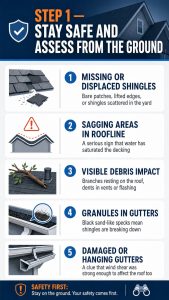
Step 1 — Stay Safe and Assess From the Ground
Before anything else: do not climb on a damaged roof. Even an experienced DIYer can fall through compromised decking, slip on wet shingles, or get shocked by a downed power line draped across the structure. Wait for daylight, walk a perimeter around your house, and look up.
From ground level, you can usually spot:
- Missing or displaced shingles — bare patches, lifted edges, or shingles scattered in the yard
- Sagging areas in the roofline (a serious sign that water has saturated the decking)
- Visible debris impact — branches resting on the roof, dents in vents or flashing
- Granules in gutters and downspouts — those black sand-like specks mean shingles are breaking down
- Damaged or hanging gutters — a clue that wind shear was strong enough to affect the roof too
Take notes on what you see. If the damage looks severe (sagging, exposed wood, anything resembling a hole), call a professional immediately rather than waiting until morning. GRT Roofing offers 24/7 emergency response — (440) 739-7672 — and we’ll come out for a free ground-level inspection.
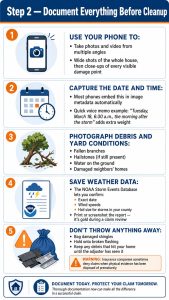
Step 2 — Document Everything Before Cleanup
This is the step homeowners skip most often, and it’s the one that costs them the most money. Before you move a single branch or sweep up a single shingle, document the scene. Use your phone to:
- Take photos and video from multiple angles. Wide shots of the whole house, then close-ups of every visible damage point.
- Capture the date and time — most phones embed this in image metadata automatically, but a quick voice memo (“Tuesday, March 18, 6:30 a.m., the morning after the storm”) adds extra weight.
- Photograph debris and yard conditions — fallen branches, hailstones (if still present), water on the ground, damaged neighbors’ homes.
- Save weather data. The NOAA Storm Events Database lets you confirm the exact date, wind speeds, and hail size for storms in your county. Print or screenshot the report — it’s gold during a claim review.
- Don’t throw anything away. Bag damaged shingles, hold onto broken flashing, and keep any debris that hit your home until the adjuster has seen it. Insurance companies sometimes deny claims when physical evidence has been disposed of prematurely.
The Insurance Information Institute’s homeowner claim guide recommends building a complete file of photos, receipts, and written notes before contacting your insurer. We agree — and we’ll happily take our own documentation when we come out for an inspection.
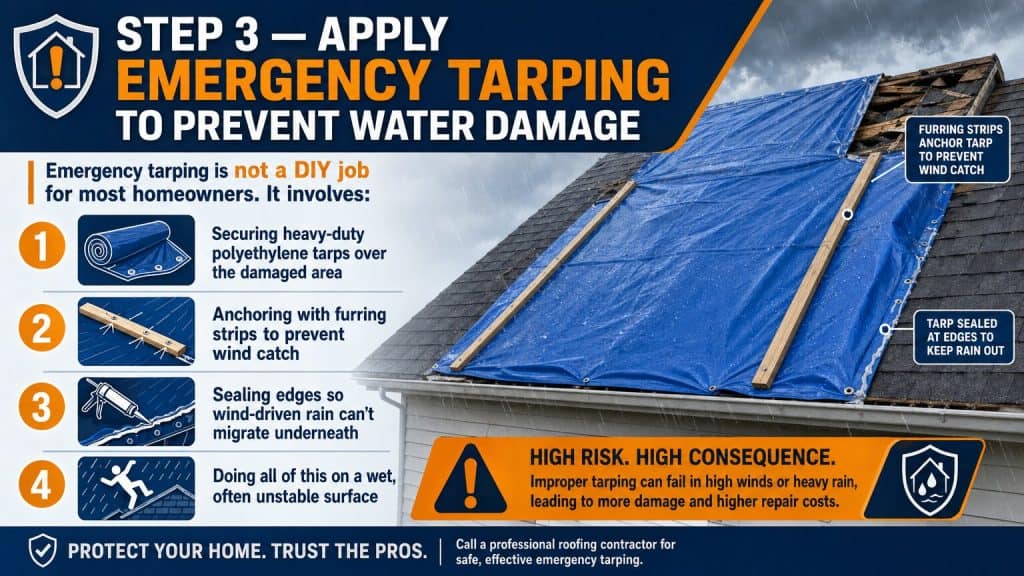
Step 3 — Apply Emergency Tarping to Prevent Water Damage
If your roof is breached, every hour matters. Water that gets past the shingles soaks into insulation, rots decking, stains drywall, and starts growing mold within 24 to 48 hours. A proper tarp is a temporary fix, not a repair — but it can save you thousands in secondary damage while you wait for the claim to process.
Emergency tarping is not a DIY job for most homeowners. It involves:
- Securing heavy-duty polyethylene tarps over the damaged area
- Anchoring with furring strips to prevent wind catch
- Sealing edges so wind-driven rain can’t migrate underneath
- Doing all of this on a wet, often unstable surface
Our crew handles emergency tarping as part of our storm damage repair service, and we keep tarp materials on the truck during storm season. One important note for your claim: save every receipt for emergency mitigation work. Under most Ohio policies, the cost of reasonable temporary repairs is reimbursable on top of your main claim payout.
If water is actively dripping inside the house, also place buckets under drips, move furniture and electronics out of the path, and shut off electricity to affected rooms if water is near outlets or fixtures.
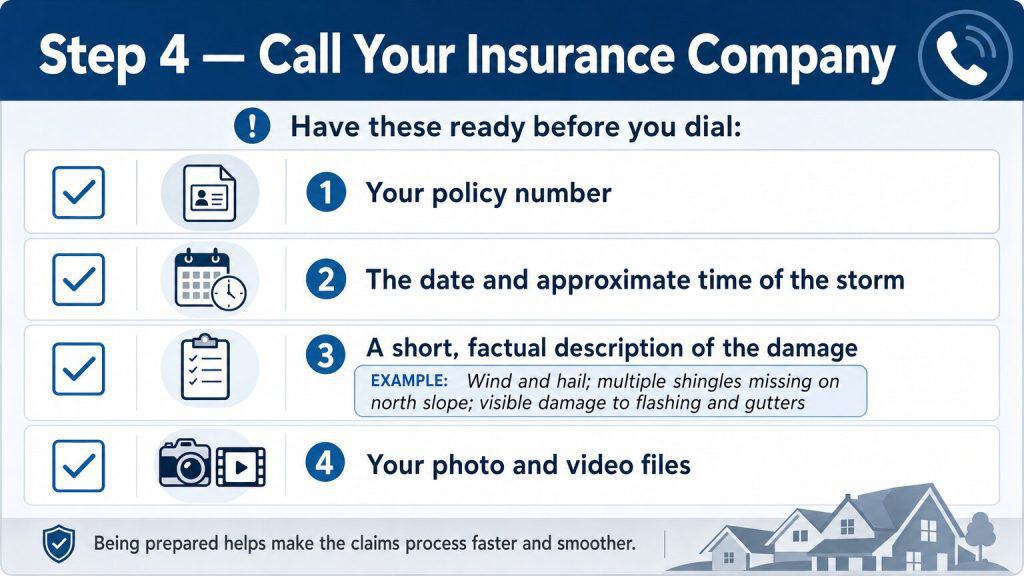
Step 4 — Call Your Insurance Company
Once your home is stable and documented, contact your carrier to start the claim. Have these ready before you dial:
- Your policy number
- The date and approximate time of the storm
- A short, factual description of the damage (“Wind and hail; multiple shingles missing on north slope; visible damage to flashing and gutters”)
- Your photo and video files
The carrier will assign a claim number and schedule an adjuster visit, usually within 3 to 14 days depending on storm volume in your area. After a major regional event, adjusters can be backed up for weeks — file early to get in the queue.
A few Ohio-specific things to know:
- You have one year from the date of loss to file. Don’t push it to the deadline; aging damage is harder to attribute to a specific storm.
- You have the right to choose your own contractor. Your insurance company may suggest a “preferred” roofer, but you are not required to use them. The Ohio Department of Insurance consumer claim guide confirms this right and walks through the claim process step by step.
- Have a contractor present during the adjuster visit. This single decision often makes a five-figure difference. Adjusters work fast, sometimes miss damage on roof slopes they can’t safely access, and aren’t roofing experts. A licensed local contractor on-site ensures every legitimate item gets documented in the estimate.
Step 5 — Get an Independent Roof Inspection
Even if your insurance adjuster has already visited, you still need an independent professional to look at your roof. Adjusters are evaluating your claim for the insurance company; an independent contractor is evaluating it for you. The two estimates often differ — sometimes by a lot.
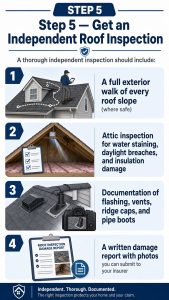
A thorough independent inspection should include:
- A full exterior walk of every roof slope (where safe)
- Attic inspection for water staining, daylight breaches, and insulation damage
- Documentation of flashing, vents, ridge caps, and pipe boots
- A written damage report with photos you can submit to your insurer
Our free roof inspection service gives you a written report and side-by-side comparison with the adjuster’s estimate. If we find missed items, we’ll help you request a re-inspection or a supplemental claim. If the damage is extensive enough that repair isn’t cost-effective, we’ll walk you through the full roof replacement option — including financing if it’s needed.
Step 6 — Choose Your Roofing Contractor Carefully
After every major storm in Northeast Ohio, out-of-state “storm chasers” descend on neighborhoods, knock on doors, and pressure homeowners into signing on the spot. Some are legitimate. Many are not. The pattern is predictable: collect the insurance check, do a fast and flawed install, and disappear before warranty issues surface.
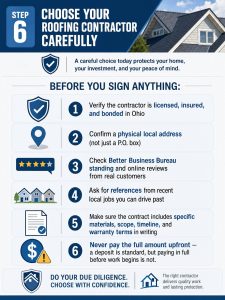
Protect yourself by hiring a licensed, local Ohio contractor with a permanent address and a real reputation. Our companion guide, how to choose a roofing contractor in Cleveland without getting burned, walks through every red flag — but at minimum, before you sign anything:
- Verify the contractor is licensed, insured, and bonded in Ohio
- Confirm a physical local address (not just a P.O. box)
- Check Better Business Bureau standing and online reviews from real customers
- Ask for references from recent local jobs you can drive past
- Make sure the contract includes specific materials, scope, timeline, and warranty terms in writing
- Never pay the full amount upfront — a deposit is standard, but paying in full before work begins is not.
GRT Roofing has served the North Olmsted and Greater Cleveland area for over 25 years, with an A+ BBB rating and a team whose combined experience exceeds 100 years. We’re not going anywhere when warranty season arrives.
Frequently Asked Questions
How long do I have to file a storm damage claim in Ohio?
Most Ohio homeowner policies give you one year from the date of loss to file a claim, though some policies are stricter. Read your policy’s “Duties After Loss” section for the exact deadline. Even with a year on the clock, file as soon as possible — the longer you wait, the harder it is to prove the damage came from a specific storm rather than gradual wear.
Will my insurance cover a full roof replacement after a storm?
It depends on the extent of damage and your policy type. If more than roughly 25% of your roof’s surface is damaged, most policies (and many Ohio building codes) require a full replacement rather than a patch repair. Your payout amount also depends on whether you have an Actual Cash Value (ACV) policy, which deducts depreciation, or a Replacement Cost Value (RCV) policy, which pays for a brand-new roof. A licensed contractor and a careful read of your policy’s declarations page will tell you exactly where you stand.
What if my neighbor’s tree fell on my roof?
Counterintuitively, your own homeowner’s insurance — not your neighbor’s — typically covers the damage. Insurance treats falling trees as an “act of nature,” and the policy that pays is the one belonging to the property where the damage occurred. The exception is if you can prove your neighbor was negligent (for example, the tree was visibly dead and they ignored repeated warnings). Document everything, file with your own insurer first, and let the adjusters sort out subrogation between the two policies.
Get a Free Storm Damage Inspection
If a storm just hit your home, the smartest first call is the one that costs you nothing. A free GRT Roofing inspection gives you a written damage report, photos, and a clear path forward — whether that means a small repair, an insurance claim, or a full replacement. We serve North Olmsted, Cleveland, and surrounding suburbs with 24/7 storm response.
Call (440) 739-7672 or contact our team online to schedule your inspection.